
Commerce & Affiliate
D2C, B2B2C and marketplace commerce
FMCG and retail brands launching direct channels, marketplace operators, and D2C businesses that have outgrown a hosted storefront.
How it works
How an affiliate order moves from partner link to commission statement
- Automated
- Person decides
- Partner links and codes
- Multi-brand catalog
- Customer behavior
- Settled multi-brand orders
- Partner statements
- Channel performance
Discover
Personalized discovery uses purchase and browsing behavior to order what each customer sees across brands, and the promotions engine applies whatever the campaign calendar has running.
Rule-based and automatic, logged in the audit trail.
Attribute the order
When a customer arrives through a partner link or code, the attribution is recorded on the order, along with the brand and the commission plan that applies.
Rule-based and automatic, logged in the audit trail.
Pay and allocate
Payment runs through one of more than ten gateways chosen per market. Stock is allocated from inventory shared or ring-fenced per brand and channel, and a multi-brand order settles to each brand.
Rule-based and automatic, logged in the audit trail.
Fulfill
Fulfillment routing sends each order to the logistics integration configured for that market and brand.
Rule-based and automatic, logged in the audit trail.
Calculate commission
Commission is calculated at order confirmation against the partner's plan, including multi-tier plans, held through the return window and then released to a statement.
Rule-based and automatic, logged in the audit trail.
Resolve and approve
Partner approvals, commission disputes and pricing decisions stay with your team, working from the same order and commission records the partner dashboard reads.
A person makes this call. The system gives them the context.
Who it is for
When a hosted storefront runs out of room for partners and brands
Commerce & Affiliate is a commerce platform for businesses selling through more than one channel and more than one partner. It handles the parts standard platforms leave out: affiliate structures, commission logic, group buying and multi-brand inventory. Hosted storefronts are excellent at one brand selling to one consumer. This platform was built where the workarounds ran out.
Because the core is built, your catalog structure, commission rules and fulfillment integrations can be configured and live in 4–6 weeks. A mid-scale retail and FMCG brand launched multi-channel commerce with affiliate management on this platform over 18 months. Platforms of this type support market share growth of up to 37% in target segments.
-
A second brand turns the storefront into workarounds
Hosted storefronts are excellent at one brand selling to one consumer. A second brand, a reseller tier or a commission scheme starts the workarounds.
-
Affiliate commission logic lives in a spreadsheet
Affiliates are a plug-in, so what each partner is owed is worked out outside the platform every month.
-
Inventory gets double-counted across brands
Without multi-brand stock in the core data model, shared and ring-fenced inventory drift apart across channels.
-
Multi-brand is sold as an enterprise upgrade
Standard platforms price multi-brand as its own tier, and even then it is not native to the data model.
-
Partner performance needs a reconciliation first
When an order does not know which partner brought the customer, every channel report starts with matching exports.
-
An FMCG brand is launching a direct channel
Direct sales, resellers and affiliates arrive together, and a platform built for a single channel was never designed for the mix.
The platform
What Commerce & Affiliate gives you.
Modules in production, ready to configure
-
Multi-brand catalog
Each product belongs to a brand with its own pricing rules. Inventory is shared or ring-fenced per brand and per channel.
-
Affiliate partner module
A tracked identity, commission plan and dashboard per partner. Multi-tier plans are configured, not coded.
-
10+ payment gateway integrations
More than ten payment gateways, chosen per market, with orders that span brands settling correctly to each.
-
Logistics and custom inventory
The major carriers integrated per market, with inventory allocation and fulfillment routing automated.
-
Group buy
A campaign type with a target quantity, a deadline and a price. The order fires at the threshold or refunds if it is missed.
-
Personalized product discovery
Purchase and browsing behavior decide the order in which each customer sees products.
-
Promotions and campaign engine
Runs the campaign calendar and applies promotions to orders automatically.
-
Commerce analytics
Performance by channel, brand, partner and campaign, queried from order data rather than reconciled.
What is different about this commerce and affiliate platform
- 01
Partners and brands in the core data model
An order knows which brand it belongs to, which partner brought the customer and which commission plan applies. Nothing is bolted on.
- 02
Commission held through the return window
Calculated at order confirmation, held until the return window closes, then released to a statement. Multi-tier plans are configuration, not code.
- 03
One table for finance and for the partner
When finance asks what a partner is owed this month, the answer comes from the same table the partner's dashboard reads.
- 04
Automation stops at the judgment calls
Attribution, commission calculation, inventory allocation, promotions and fulfillment routing are automated. Commission disputes, partner approvals and pricing decisions are not.
Inside the product
Commerce & Affiliate, screen by screen.
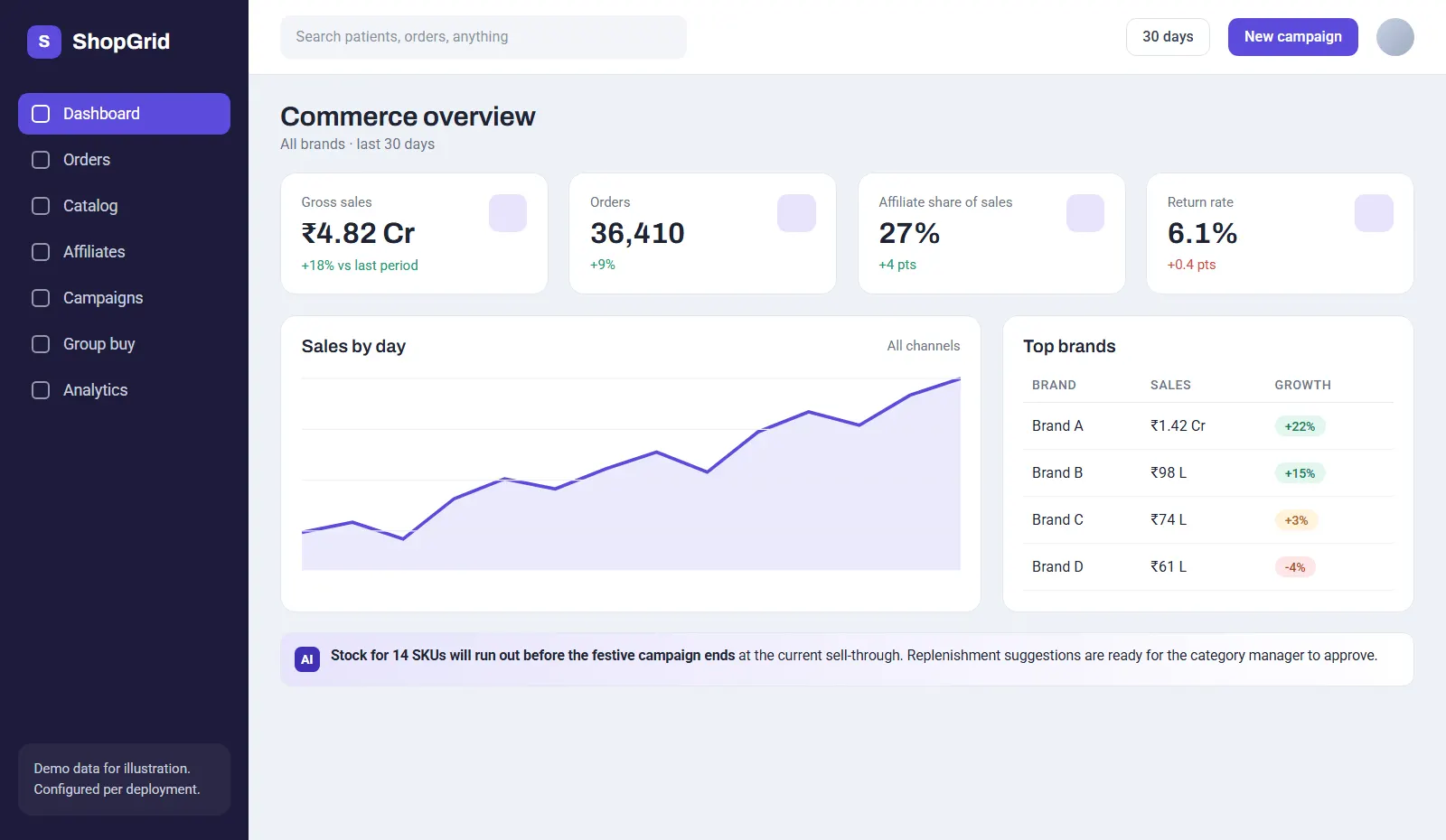
Commerce overview
Sales, orders, affiliate share and returns across brands, with a daily sales trend and early warning on stock that will run out.
- Multi-brand sales in one view
- Affiliate share of sales tracked
- Replenishment suggestions for approval
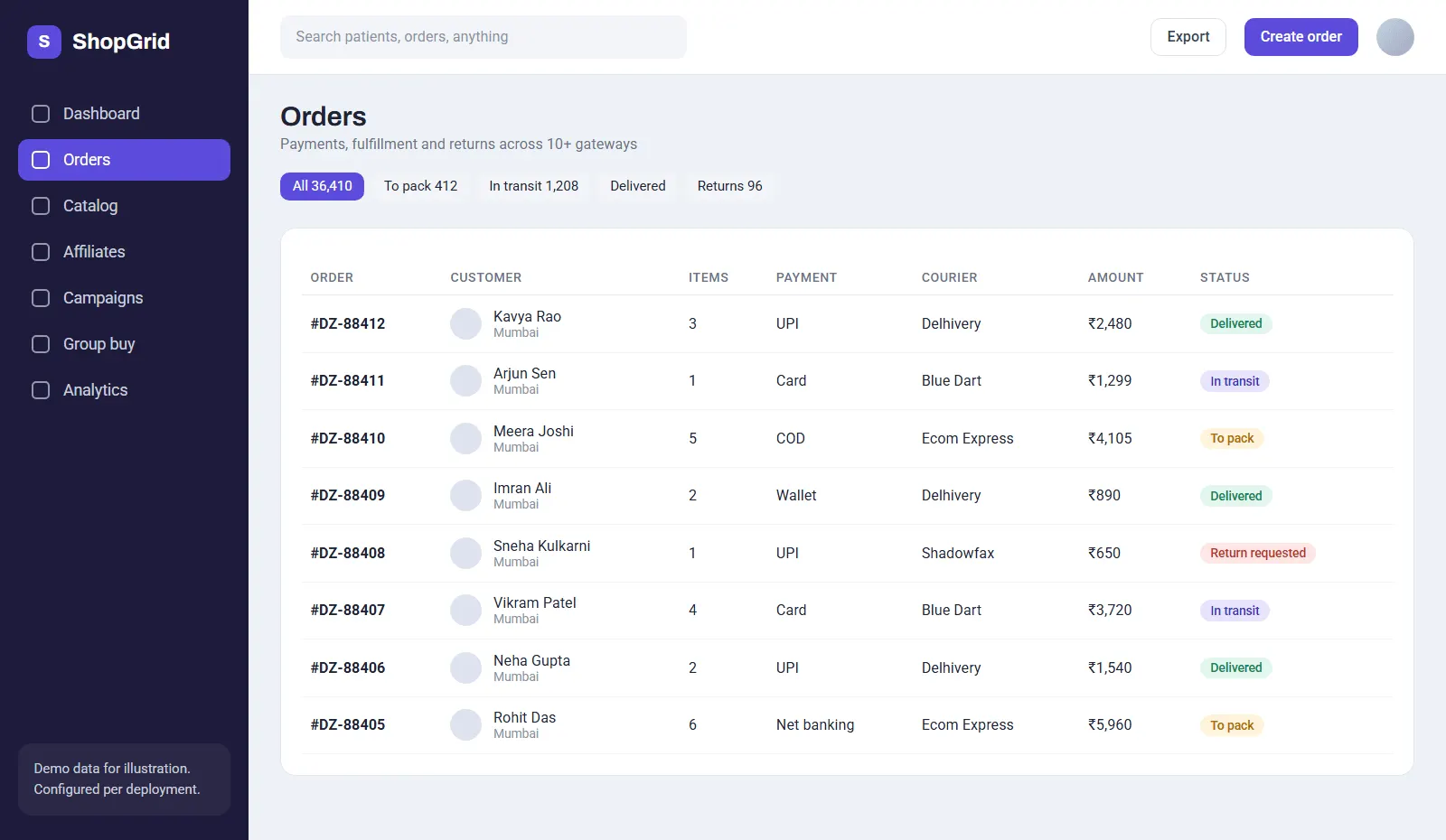
Orders and fulfillment
Every order with payment method, courier and status, from packing to delivery and returns, across payment gateways.
- Status tabs from packing to returns
- Payment and courier per order
- Returns handled in the same flow
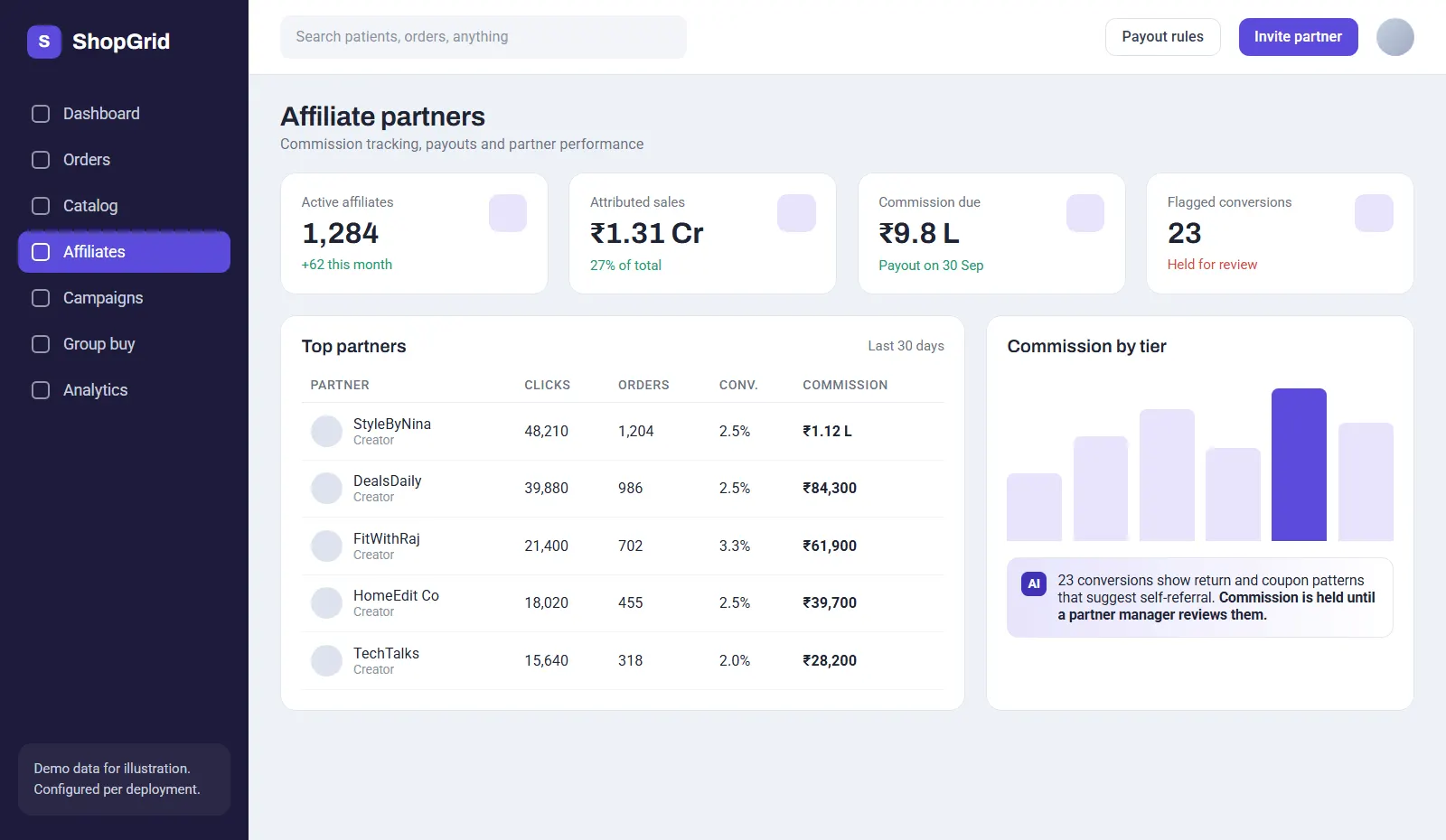
Affiliate partners
Clicks, orders, conversion and commission per partner, commission by tier, and suspicious conversions held for review.
- Commission tracking per partner
- Payout dates and rules
- Self-referral patterns held for review
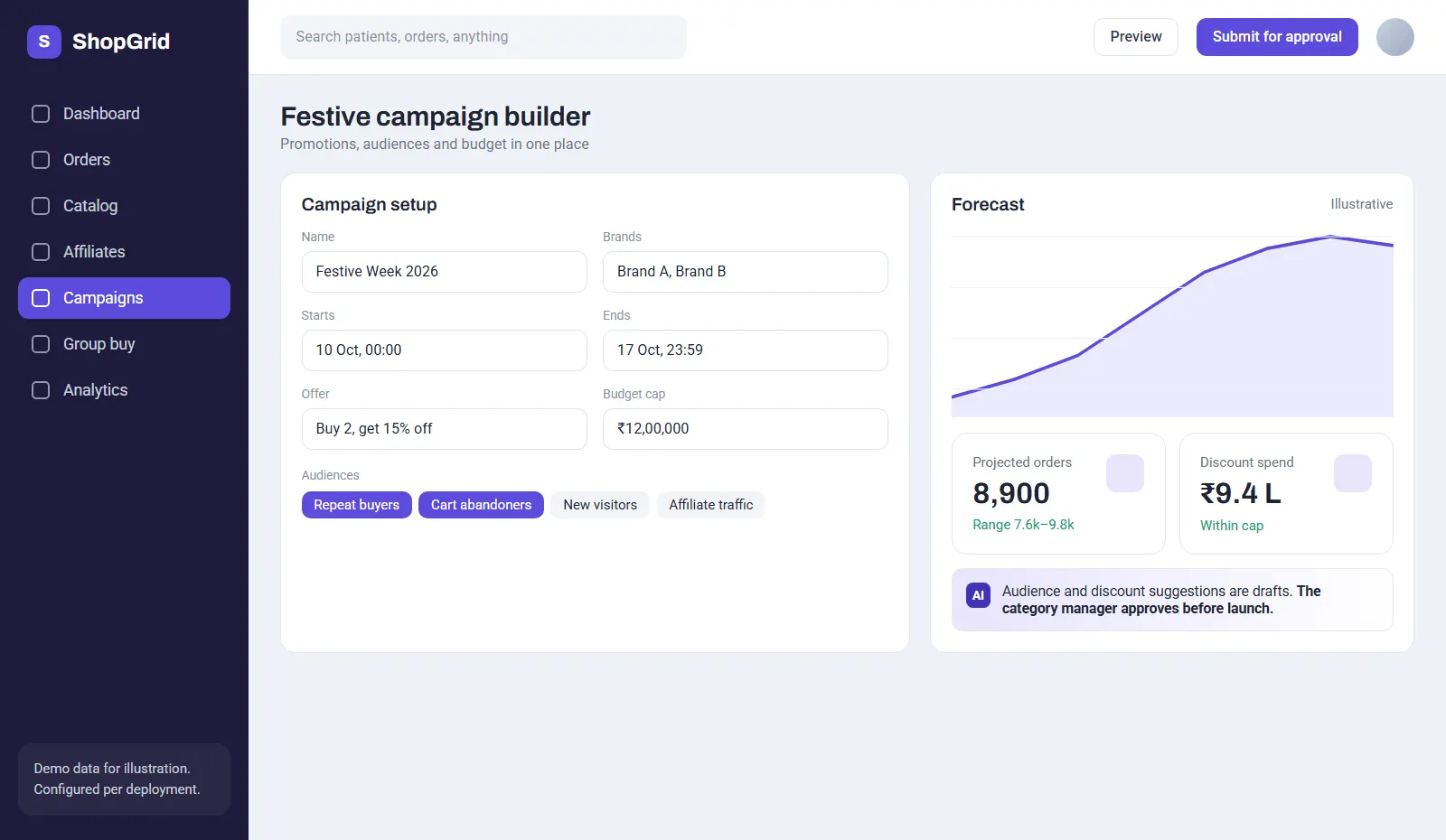
Campaign builder
Offers, dates, brands, budget caps and audiences in one form, with a forecast before the campaign goes for approval.
- Budget cap and schedule
- Audience selection
- Forecast before launch
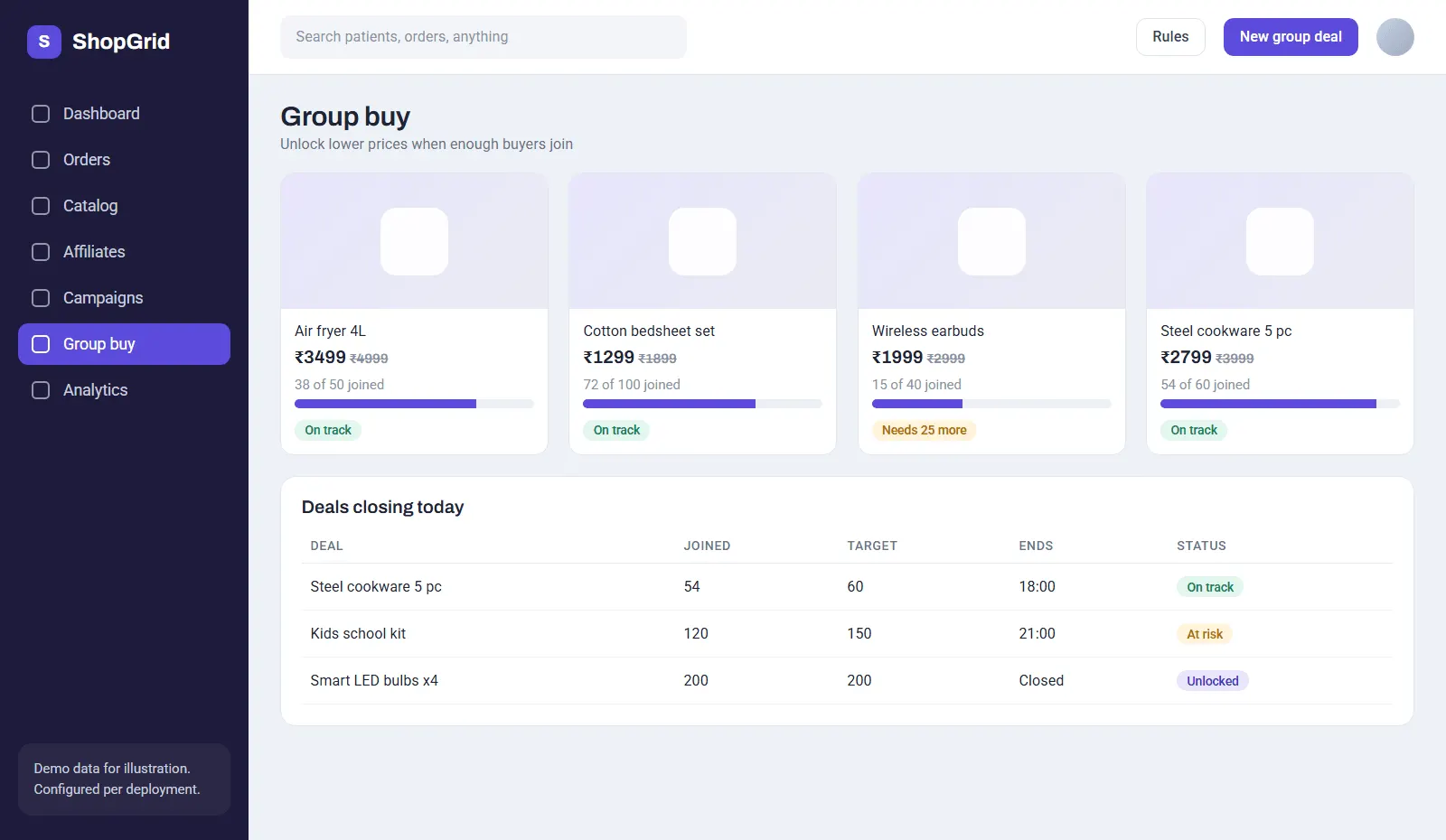
Group buy
Deals that drop to a lower price once enough buyers join, with progress per deal and the ones closing today.
- Join progress per product
- Deals at risk flagged
- Completed deals closed automatically
Concept screens showing how this platform is typically configured. Demo data only.
Concept screens showing how this platform is typically configured. Demo data only.
Architecture
What Commerce & Affiliate runs on.
The reference architecture we deploy. The crimson application services are where we configure for you; identity, workflow, storage and observability are already built and in production.
Architecture of the Commerce and Affiliate. Users: Shoppers, Affiliate partners, Brand operations, Marketing. Edge and access: CDN and WAF (CloudFront), Load balancer (ALB, multi-AZ), Identity (social and email login). Application services: Storefront (React web and app), Commerce API (Node.js), Affiliate and commission (attribution), Recommendations (Python). Data: Orders (RDS PostgreSQL), Catalog (MongoDB), Cart and sessions (ElastiCache Redis). Integrations: Payment gateways (10+), Logistics partners (tracking), Email and SMS (SES, SNS), Tax and invoicing (GST-ready). Storage and delivery: Product media (S3), Read replica (reporting load), Static delivery (CloudFront). Events and analytics: Order events (SQS), Sales and affiliate dashboards (daily), Loyalty segments (retention). Observability and security: Alarms and logs (CloudWatch), Audit trail (append-only), Secrets and keys (KMS), Backups (point-in-time).
Team and timeline
4–6 weeks
to your catalog and commission rules live
Indicative. Actual duration depends on requirements and complexity, and can change.
Who sets it up
- Solution architect
- Full stack engineers
- Integration engineer
- QA engineer
- Delivery lead
Good to know
The platform exists, so the work is your catalog structure, commission rules and fulfillment integrations. Payment gateway and carrier onboarding on your side usually set the pace.
Proof
Where this platform has run.

How an FMCG brand increased market share by 37% through digital commerce
increase in market share

How a global fashion retailer increased customer engagement by 34%
increased customer engagement
FAQ
Commerce & Affiliate: common questions.
When should we move off a hosted storefront?
When the workarounds start. A hosted storefront is the right choice for one brand selling to one consumer. Once a second brand, a reseller tier or a commission scheme appears, the commission logic moves into a spreadsheet and inventory starts getting double-counted. That is the point at which a platform with partners and brands in its core data model costs less than the workarounds.
How are affiliate commissions calculated and paid?
Each affiliate has a tracked identity and a commission plan. When a customer arrives through a partner link or code, the attribution is recorded on the order. Commission is calculated at order confirmation against the plan, held through the return window, and released to a statement. Multi-tier plans, where a partner earns on partners they introduced, are configured. Disputes go to a person on your team.
Can one order include products from several brands?
Yes. The catalog is multi-brand from the ground up: each product belongs to a brand, and each brand has its own pricing rules. Inventory can be shared or ring-fenced per brand and per channel. A single order can span brands and still settle correctly to each, and reporting by brand is a query on that order data rather than a reconciliation.
What do we need in place before launch?
A catalog export with brands and pricing rules, the commission plans you intend to offer partners, a merchant account with a payment gateway in each market you sell to, and carrier agreements for fulfillment. Gateway and carrier onboarding often take longer than configuration, so we recommend starting those applications in the first week.