
Healthcare & Life Sciences
Patient engagement, scheduling and trial data platforms
Multi-site healthcare providers, hospital networks, life sciences organizations and CROs.
How it works
How bookings and trial sites move through the platform
- Automated
- AI under rules
- Person decides
- Web and mobile bookings
- Call center requests
- Trial site data
- Filled, confirmed schedule
- Shared patient record
- Trial progress dashboards
- Clinical and ops reports
Request from any channel
A booking request arrives from the web, the mobile app or the call center. All three write to the same schedule, so no channel works from its own copy.
Rule-based and automatic, logged in the audit trail.
Slots offered by rules
The engine knows each site's capacity, each clinician's availability and the rules for each appointment type, and offers only slots that fit the pathway, so the front desk is not correcting bookings later.
Rule-based and automatic, logged in the audit trail.
Gaps filled
Scheduling optimization, using ML where the booking history supports it, fills gaps and reduces the slots left empty by late cancellations.
AI runs within agreed thresholds; anything outside them goes to a person.
Reminders and follow-up
Confirmation, reminders at configured intervals, pre-visit instructions and follow-up go out through the patient's preferred channel, taking over the no-show chasing once done by phone.
Rule-based and automatic, logged in the audit trail.
Care and exceptions
The clinical decision, any exception the rules did not anticipate and any communication that needs a human voice stay with staff, who all work from the same centralized patient record.
A person makes this call. The system gives them the context.
Trial progress tracked
Enrollment, visit completion and data quality are tracked across trial sites. Dashboards show which sites are behind and where queries are outstanding, and LSHCS integration keeps records aligned.
Rule-based and automatic, logged in the audit trail.
Who it is for
Where multi-site providers and trial teams lose time today
This platform is built for multi-site healthcare providers, hospital networks, life sciences organizations and CROs. On one side it runs appointments and patient engagement: bookings from web, mobile and the call center into one schedule, automated reminders and a shared patient record. On the other it runs trial data monitoring across sites. Both share an engine, because both are scheduling, communication and compliant record-keeping underneath. Care pathways, site structure and compliance rules are configured, and a first site and channel is typically live in 4–6 weeks.
A global healthcare organization replaced an outdated scheduling system across web, mobile and call center in a 12 month fixed-cost engagement. Platforms of this type increase daily appointment bookings by up to 40%.
-
Practice software was built for one site and a receptionist
It struggles with multi-site capacity, several booking channels and the compliance requirements of a large provider.
-
Enterprise hospital systems take years to deploy
They have the scale, but scheduling and patient communication problems wait behind a multi-year rollout.
-
Bookings get corrected after the fact
When channels do not share pathway rules, the front desk spends its time fixing appointments booked into the wrong slot or site.
-
Staff chase no-shows by phone
Late cancellations leave empty slots, and reminders depend on someone having time to make the calls.
-
Trial sites fall behind before anyone notices
Without progress tracking across sites, lagging enrollment and outstanding queries surface late.
-
Running studies means a second vendor
A provider that also runs trials ends up with one system for patient scheduling and another for monitoring study sites.
The platform
What Healthcare & Life Sciences gives you.
Modules in production, ready to configure
-
Multi-channel appointment booking
Web, mobile app and call center bookings written to one schedule that knows capacity and pathway rules.
-
Automated patient reminders
Confirmations and reminders at configured intervals through the patient's preferred channel.
-
Centralized patient data repository
One record for front desk, clinician and call center. A change at one desk is visible at the others at once.
-
Care communication workflows
Pre-visit instructions and follow-up sequenced per appointment type, with reminder cadences as settings.
-
Trial data monitoring
Enrollment, visit completion and data quality tracked across sites in one view.
-
Progress tracking
Dashboards showing which sites are behind and where queries are still outstanding.
-
LSHCS integration
Integration with LSHCS systems keeps the operational and clinical records aligned.
-
Clinical and operational reporting
Routine clinical and operational reports generated automatically across sites.
What is different about the healthcare and life sciences platform
- 01
Multi-site and multi-channel from the start
Web, mobile and call center write to one schedule that knows every site's capacity and every clinician's availability.
- 02
Settings, not releases
Site structure, pathway definitions and reminder cadences are settings the operations team changes without a release.
- 03
One engine for patients and trials
Both sides are scheduling, communication and compliant record-keeping underneath, so a provider that also runs studies does not need a second vendor.
- 04
Start with one site and one channel
Deployment widens as the operations team gains confidence. In the reference program the call center went live first, so the people who knew the old system best checked the new one.
Inside the product
Healthcare & Life Sciences, screen by screen.
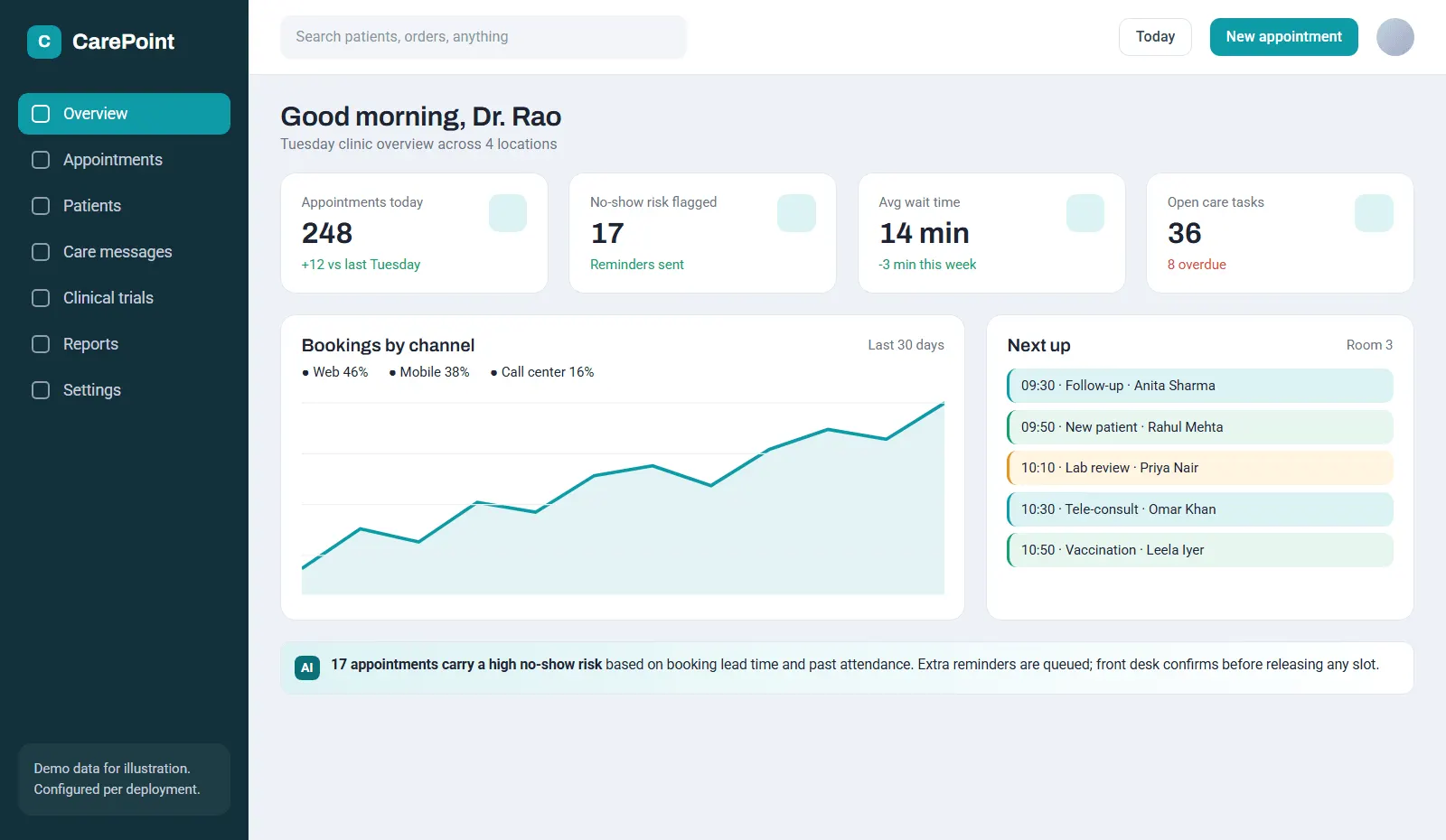
Clinic overview
Appointments, wait time and open care tasks across locations, bookings by channel, and the next patients per room.
- Bookings across web, app and call center
- No-show risk flagged for reminders
- Front desk confirms before releasing slots
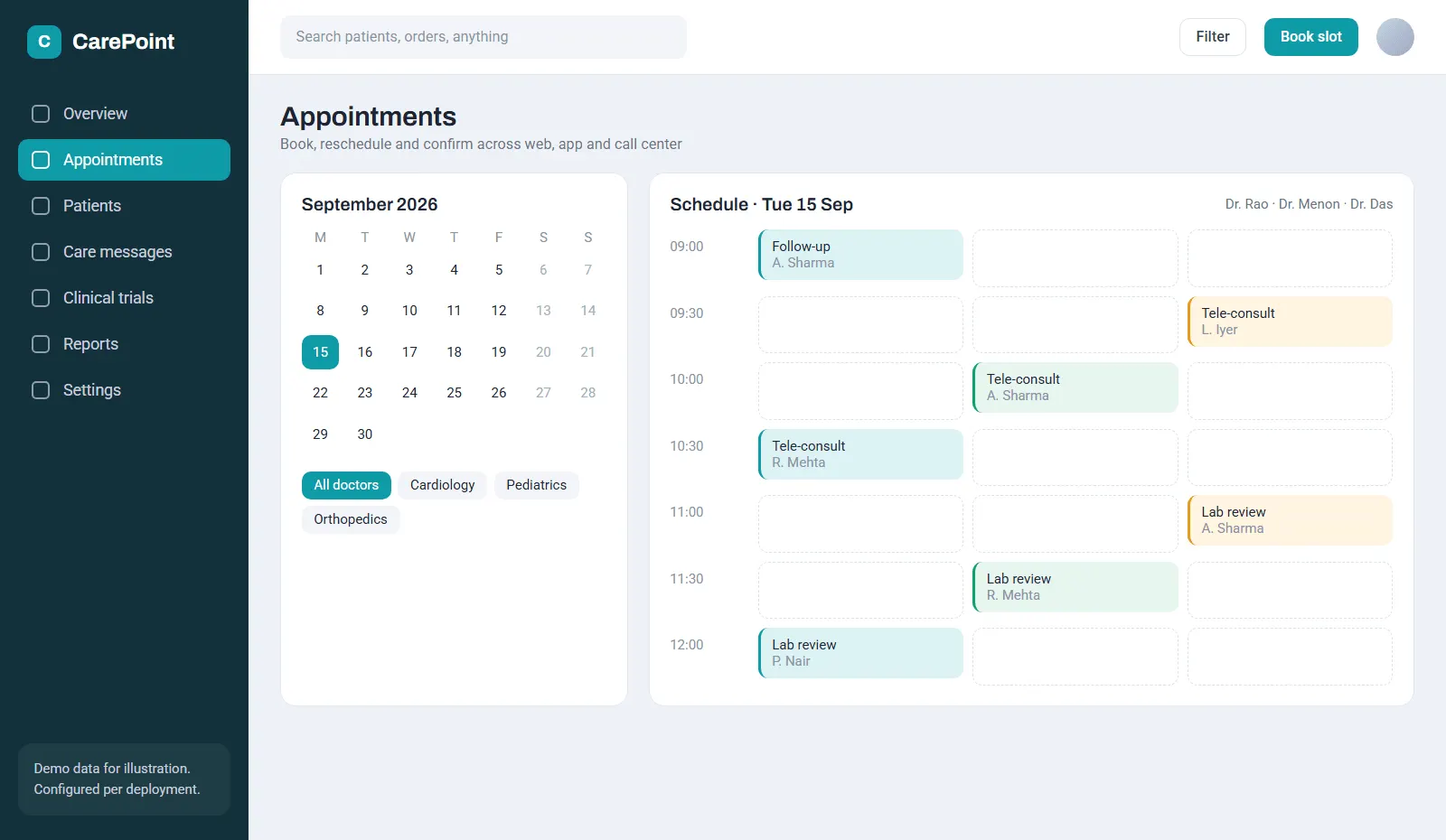
Appointment scheduling
A shared calendar across doctors and specialties for booking, rescheduling and confirming, whichever channel the patient used.
- Schedules by doctor and specialty
- Open slots visible instantly
- One view for every booking channel
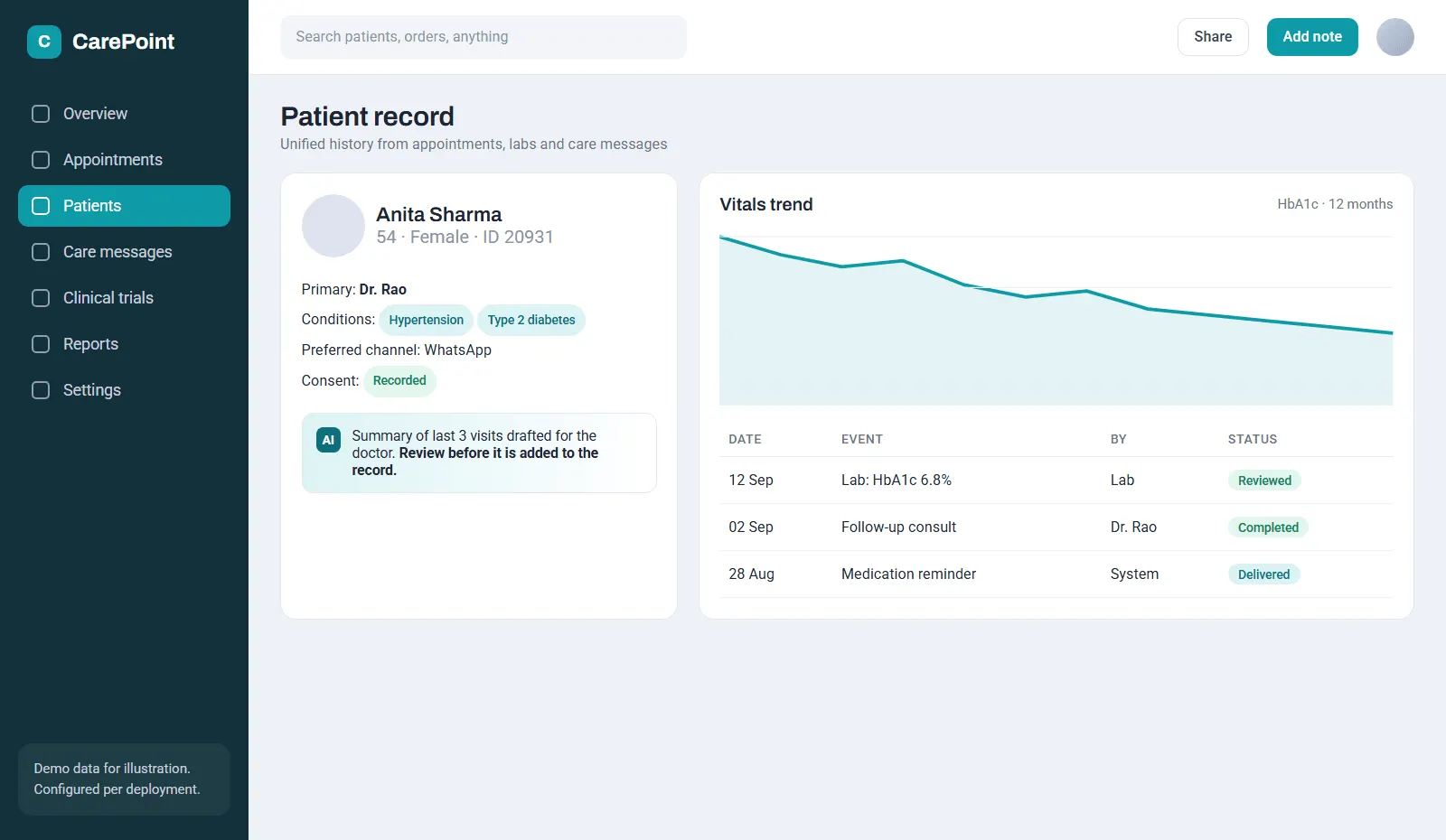
Patient record
One record with conditions, consent, preferred channel, vitals trend and the history of visits, labs and messages.
- Vitals trend over 12 months
- Consent recorded on the record
- Visit summaries reviewed by the doctor
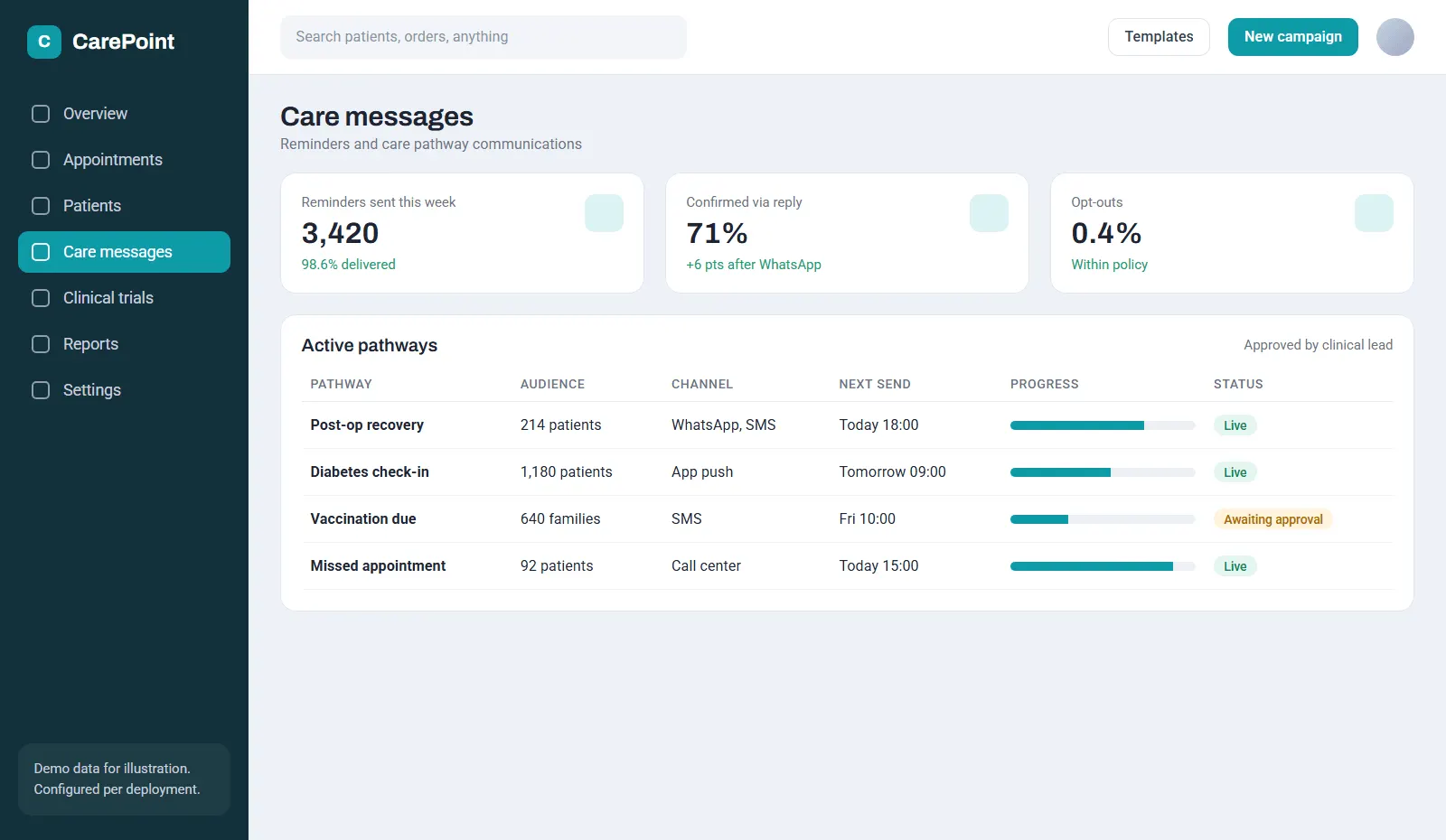
Care messages
Reminders and care pathway messages by WhatsApp, SMS and app, with delivery, confirmation and opt-out tracked.
- Pathways approved by a clinical lead
- Delivery and reply rates per campaign
- Opt-outs kept within policy
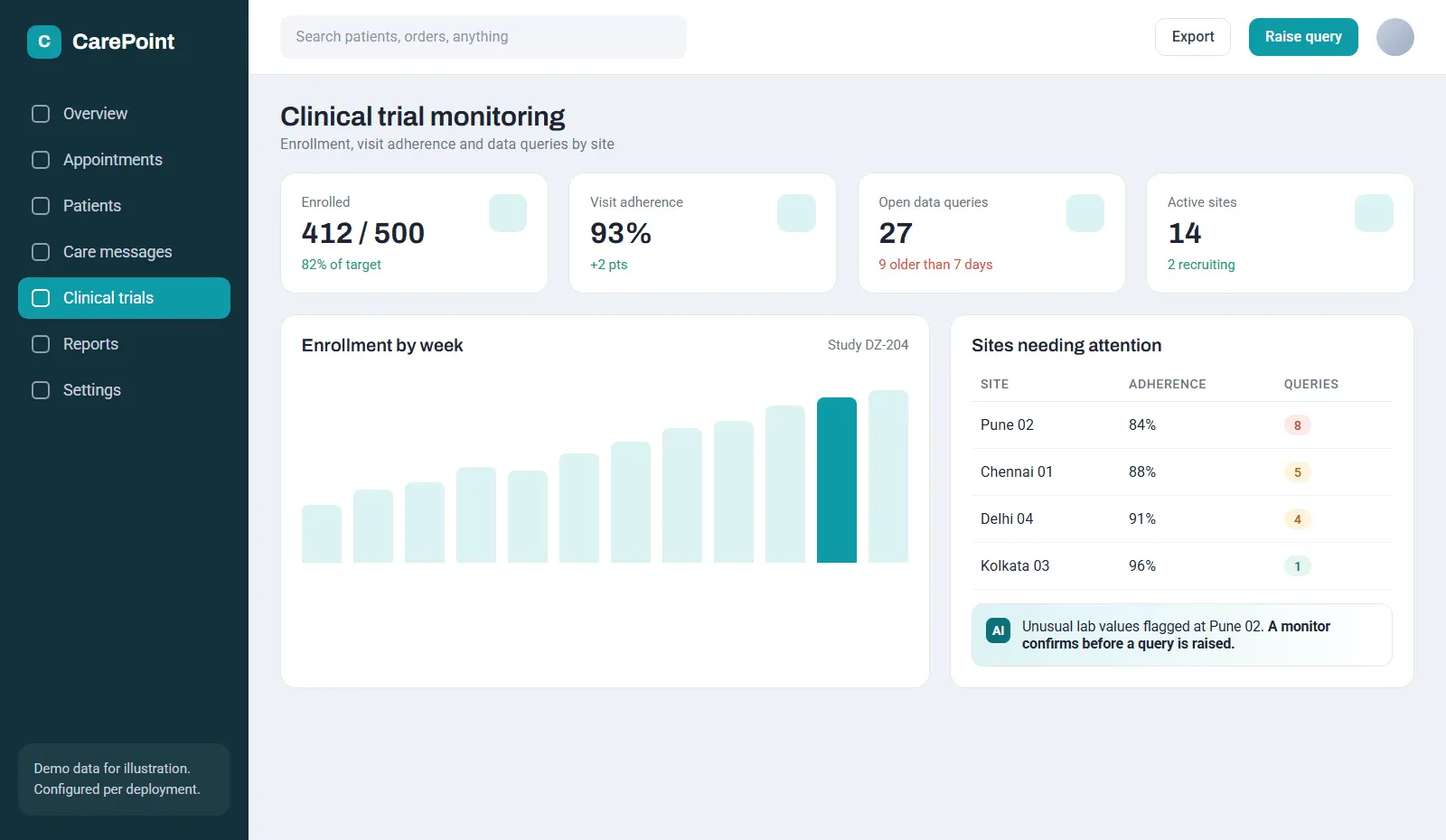
Clinical trial monitoring
Enrollment against target, visit adherence and open data queries by site, with the sites that need attention first.
- Enrollment by week
- Adherence and queries per site
- A monitor confirms before a query is raised
Concept screens showing how this platform is typically configured. Demo data only.
Concept screens showing how this platform is typically configured. Demo data only.
Architecture
What Healthcare & Life Sciences runs on.
The reference architecture we deploy. The crimson application services are where we configure for you; identity, workflow, storage and observability are already built and in production.
Architecture of the Healthcare and Life Sciences. Users: Patients, Call center, Clinicians, Operations. Edge and access: CDN and WAF (CloudFront), Load balancer (ALB, multi-AZ), Identity and consent (Cognito, OTP). Application services: Patient web and app (React), Scheduling API (Node.js), Slot optimization (Python model), Reminder workers (queues). Data: Patient and schedule data (RDS PostgreSQL, encrypted), Slot locks (ElastiCache Redis). Integrations: SMS and WhatsApp (reminders), Email (SES), Call center telephony (CTI), Maps and locations (site finder). Storage and delivery: Encrypted records (S3), Read replica (reporting load), Static delivery (CloudFront). Analytics: Booking funnel (by channel), No-show prediction (model), Ops reporting (by site). Observability and compliance: Alarms and logs (CloudWatch), Access audit log (every read), Encryption keys (KMS), Backups (point-in-time).
Team and timeline
4–6 weeks
to your first site and channel live
Indicative. Actual duration depends on requirements and complexity, and can change.
Who sets it up
- Solution architect
- Integration engineer
- Data and ML engineer
- QA engineer
- Delivery lead
Good to know
Pathways, sites and reminders are configuration. Access to clinical systems and your compliance review set the pace, and further sites and channels widen after the first is live.
Proof
Where this platform has run.

How a global healthcare organization increased appointment bookings by 40%
increase in daily bookings
FAQ
Healthcare & Life Sciences: common questions.
Can we start with one site before rolling out everywhere?
Yes, and we recommend it. Deployment starts with one site and one channel and widens as the operations team gains confidence. In the reference program the call center went live first, because that is where the staff were, and the web and mobile channels followed onto a schedule that was already running. The people who knew the old system best checked the new one.
What do you need from our IT and compliance teams?
From IT, access to the clinical and scheduling systems the first site uses and a named contact for integration questions. From compliance, a review of how patient data is stored, who can see it and how consent is recorded, ideally before configuration rather than after. From operations, one site and one channel willing to go first.
What stays with clinical and front-desk staff?
Slot offering, reminders, rescheduling, progress tracking and routine reporting are automated. The clinical decision, the exception the rules did not anticipate and any communication that needs a human voice stay with people. Because the front desk, the clinician and the call center see the same centralized record, a change made at one desk is visible at the others immediately.
Does the platform support clinical trials as well as patient scheduling?
Yes. Trial data monitoring tracks enrollment, visit completion and data quality across sites, and progress dashboards show which sites are behind and where queries are outstanding. Integration with LSHCS systems keeps operational and clinical records aligned. Both sides share the same engine, so an organization that runs studies alongside patient care does not need a second vendor.
What outcomes can a multi-site provider expect?
Platforms of this type increase daily appointment bookings by up to 40%. That pattern comes from a 12 month fixed-cost engagement in which a global healthcare organization replaced an outdated scheduling system across web, mobile and call center. It is a projection of what the pattern does, not a client-confirmed result, and the right figure for you depends on your sites, channels and starting point.